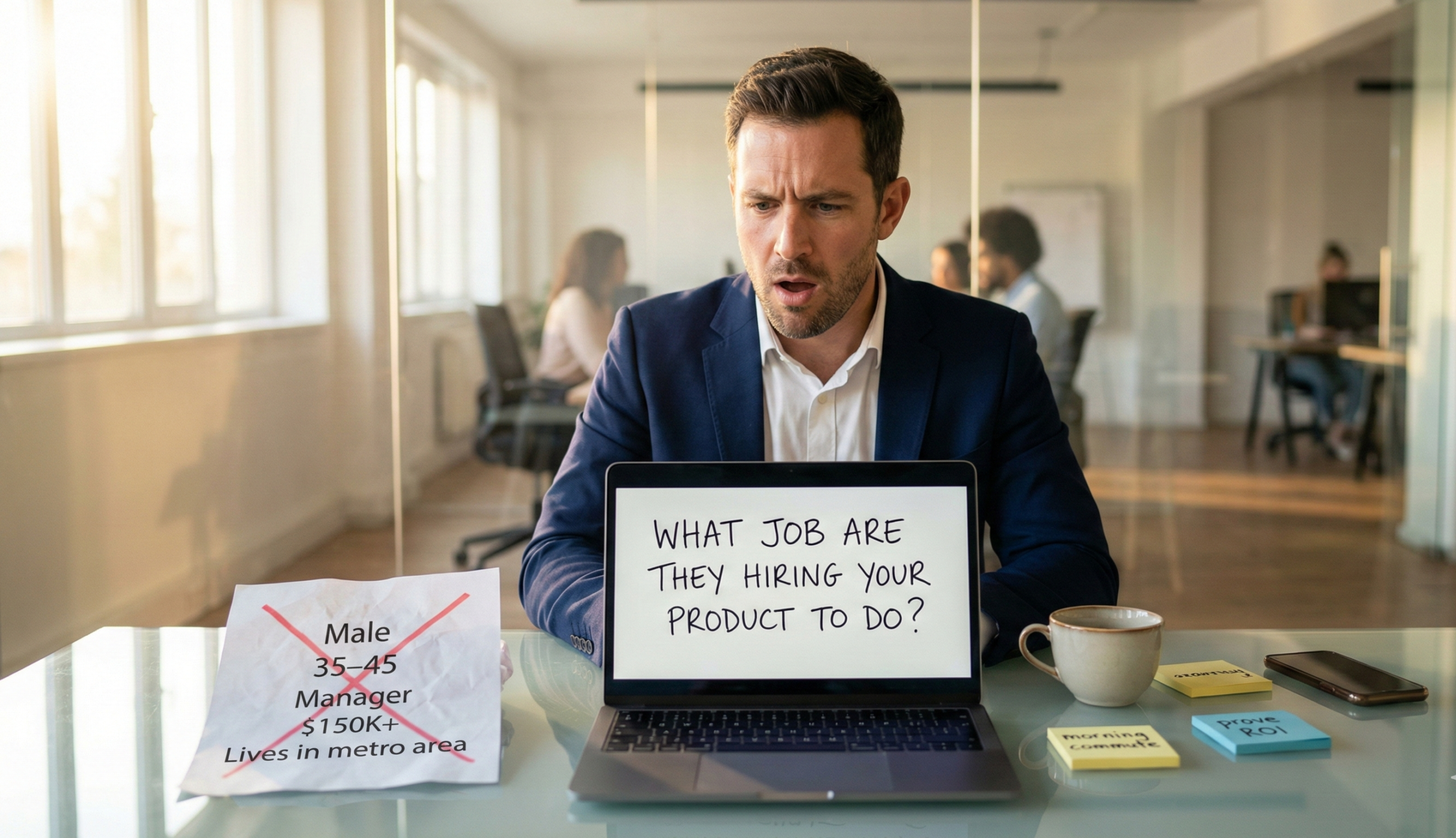
Key Takeaways
Demographics-based customer profile B2B approaches don’t drive purchases. The JTBD (Jobs To Be Done) framework focuses on what customers are trying to accomplish — not who they are. One B2B client saw 3.4x higher demo conversion after switching from demographic targeting to JTBD messaging. Below: the 5-step framework to discover your customers’ real jobs.
Last updated: March 21, 2026
A customer profile B2B built on demographics fails because people don’t buy based on age or income — they buy to accomplish a specific job in their lives. The Jobs To Be Done framework replaces “who is the customer” with “what situation triggers the purchase.” Applying it increased one B2B client’s demo conversion from 0.8% to 2.7% — a 3.4x jump — without changing the product or targeting.
I was once sitting in a meeting with a client who had the perfect persona. Literally textbook perfect. “Male, 35-45 years old, middle manager, earns over $40,000 annually, lives in a major city, drives a BMW 3 Series, reads Harvard Business Review.” The campaign was beautifully targeted. Budget of $15,000 monthly. Creative agency from Warsaw. Everything tip-top.
Conversion? 0.4%.
“But that’s our customer!” the marketing director screamed on the call. And he was right. Demographically, that was their customer. Except demographics isn’t the reason people buy.
That was one of my most expensive lessons. Over the next 13 years of managing campaigns for over 100 clients, I understood a fundamental truth: people don’t buy products because they’re 35-45 years old and earn $40k. People buy products to accomplish a specific JOB in their lives.
And that changes everything about how you should build your campaigns — something I explore in depth in my guide to creating customer profiles that convert.
The Problem with Demographics: You’re Speaking to a Resume, Not a Person
Look at a typical persona I see with most clients. “Anna, 32 years old, HR specialist at a technology company, college educated, lives in Krakow, interested in personal development and yoga.”
What does this tell you about WHY Anna will buy your product? Absolutely nothing. No buyer persona template can fix this if the inputs are wrong.
Because you see, Anna doesn’t wake up in the morning thinking: “I’m a 32-year-old HR specialist from Krakow, I think I’ll buy some recruitment software today.” Anna wakes up in the morning thinking: “Damn, I have 47 resumes to review, the boss wants a shortlist by Friday, and I haven’t finished the onboarding report for new employees yet. How am I going to handle all this?”
That’s the difference between demographics and real motivation. And that difference determines whether your customer profile B2B strategy works or burns through your budget.
We call this the Jobs To Be Done approach—and it’s the foundation every marketing message should stand on.
Jobs To Be Done: People “Hire” Products to Get Work Done
The Jobs To Be Done concept, explored in depth in Christensen’s Competing Against Luck, was born from a simple question: why do people really buy what they buy?
The answer is surprisingly simple: people don’t buy products. People “hire” products to accomplish a specific job in their lives. When that job is done, they “fire” one product and “hire” another.
Sounds abstract? Let me show you an example that changed my thinking about marketing.
The McDonald’s Milkshake Story That Should Hang in Every Marketing Department
McDonald’s had a problem. They wanted to increase milkshake sales. (This is the famous HBS milkshake marketing case.) So they hired a research team that did exactly what most companies do: analyzed buyer demographics.
Age. Gender. Income. Location. They created personas. Conducted focus groups. Asked people: “How can we improve the shake? Want it more chocolatey? Bigger? With toppings?” People answered. McDonald’s made changes.
Sales? Didn’t budge.
Then Clayton Christensen from Harvard stepped in and asked a different question: “What JOB does the shake perform for the customer?”
The team started observing. Not asking—observing. And they discovered something fascinating.
73% of shakes were bought in the morning, before 8:30 AM. By people who were alone. Who came in, bought a shake, got in their car, and drove away.
When they stopped them and asked “What job does this shake do for you?”, the answers were surprisingly consistent:
“I have a 40-minute drive to work. It’s boring. I need something I can hold with one hand because the other is on the steering wheel. The shake is thick, so it lasts the whole trip. And I’m not hungry until lunch.”
That was the shake’s job: “Make my boring commute more enjoyable, and keep me from being hungry until lunch.”
The shake’s competition wasn’t other shakes. The competition was bananas (eaten too quickly), bagels (crumbs on the suit), protein bars (left an empty stomach after an hour), and boredom (because the alternative was eating nothing and being bored for 40 minutes).
When McDonald’s understood this job, everything changed. They started communicating the shake as “your commute companion” instead of “a delicious dessert.” They added more fruit chunks (so there was something to chew and it lasted longer). They moved the machines closer to the entrance (so the morning line moved faster).
Sales went up.
Not because they changed customer demographics. But because they understood what JOB customers wanted to accomplish.
How We Applied JTBD for a B2B Client—and Why Conversion Jumped 3.4x
Okay, the McDonald’s shake is a nice example, but you’re probably thinking: “Tom, I do B2B SaaS marketing. My customers aren’t people buying shakes in the morning. They’re directors, managers, decision-makers.”
And that’s exactly why JTBD is SO IMPORTANT in B2B. Because in B2B, decisions are even more emotional than in B2C—they’re just hidden behind a facade of “rational criteria.”
Let me show you with an example from our portfolio.
The client sold a sales intelligence platform—a tool that helps sales teams identify the best prospects. Their original persona looked like this: “VP Sales, 40-50 years old, at a technology company with 200+ employees, responsible for a team of 10-30 salespeople.”
Campaigns were precisely targeted — a classic B2B SaaS marketing setup. Budget of $11,000 monthly on LinkedIn Ads. Demo conversion? 0.8%. Weak.
We did JTBD research. We conducted interviews with 12 people who had bought the platform in the last 6 months. And we asked them a different question than usual:
“What was happening in your professional life at the moment you started looking for a solution like ours?”
The answers were revelatory. And very consistent.
Most VPs of Sales weren’t looking for “a better sales intelligence tool.” Most VPs of Sales were in a very specific situation: they had just received budget for a new tech stack from the board, BUT the board also gave them an ultimatum—ROI in 6 months or the budget goes back.
That was the JOB: “Show the board that the investment in sales tech will pay off in 6 months, so I don’t lose the budget—and my reputation as a leader who knows what they’re doing.”
See that difference? It’s not “I want a better tool.” It’s “I want to prove to my boss that I’m competent and won’t waste their money.”
We changed all the messaging. Instead of “The Best Sales Intelligence Platform” it was “Prove ROI in 90 Days or We Refund Your Money.” Instead of “Increase Team Efficiency” it was “Board Report Ready with One Click.”
Demo conversion? 2.7%. A 3.4x increase.
We didn’t change the product. We didn’t change the targeting. We changed which JOB we were speaking to.
What Are the Functional and Emotional Dimensions of JTBD?
Every job a customer wants to accomplish has two dimensions. And most marketers only see one.
The functional dimension is the obvious part. “I want to save 4 hours a week on reporting.” “I want to increase conversion by 20%.” “I want to reduce churn.”
The emotional dimension is the hidden part that customers rarely talk about directly. “I want to feel like I’m developing professionally, not stuck in a routine.” “I want my boss to see that I’m valuable.” “I want to stop waking up at night thinking about the project falling apart.”
In the McDonald’s shake example: the functional JTBD is “not being hungry until lunch.” The emotional JTBD is “not being bored for 40 minutes of driving.”
In the VP Sales example: the functional JTBD is “show ROI in 6 months.” The emotional JTBD is “not look like an idiot in front of the board.”
And here’s the key: your messaging must hit BOTH dimensions.
Messaging that only speaks to functional JTBD (“Save time,” “Increase conversion”) is flat. It doesn’t evoke emotion. And people buy with emotions and rationalize with logic.
Messaging that also hits emotional JTBD (“Stop wasting Friday mornings on boring reports. Start doing what matters for your career”)—that’s messaging that converts.
The Framework: How to Discover Your Customers’ True JTBD in 5 Steps
Okay, you have the theory. Now the practice. Think of this as a buyer persona template replacement — a structured way to build a customer profile B2B teams can actually use. How do you discover what job your product performs for customers?
We use a framework consisting of five steps. You can apply it within one week.
Step One: Forget demographics. Find the “moment of change.”
Instead of asking “Who are our customers?”, ask the question: “What was happening in our customers’ lives at the moment they started looking for us?”
This “moment of change” is the key. Because people don’t wake up one day and say “I think I’ll buy software for X.” Something had to happen. Some change. Some trigger.
Maybe they got a new project and suddenly the old way of doing things wasn’t enough. Maybe the boss gave an ultimatum. Maybe a competitor outpaced them. Maybe they hired a new person who brought different expectations.
Call 10-12 customers who bought in the last 6 months (fresh memory) — using the approach I describe in my purchase motivation discovery guide — and ask: “Tell me what was happening at your work during the period when you started looking for a solution like ours. What changed?”
And listen. Don’t interrupt. Don’t ask leading questions. Just listen.
Step Two: Use the “magic question” to uncover true motivation.
After identifying the moment of change, you need to understand deeper motivation. And here I use a
question that works phenomenally:“What do you do now in your work that you’d like to get off your plate?”
This question works because it doesn’t ask about the product. It asks about their life. And people open up completely differently.
Example from a real conversation:
Me: “What do you do now in your work that you’d like to get off your plate?”
Client: [5 seconds of silence] “Well… every Monday I spend 3 hours collecting data from five different systems for a report to the board. I have to do it because the boss wants it at the 11:00 AM meeting. Honestly? I hate Mondays.”
That’s the real motivation. Not “I need better automation.” But “I lose Monday mornings to boring work and I hate it.”
Step Three: Do “laddering”—go three levels deep.
When you have some motivation, you need to go deeper. The “laddering” technique is asking “Why?” three times:
“Why is losing Monday mornings to reports a problem?”
“Because then I don’t have time for strategic work.”
“Why is lack of time for strategic work important?”
“Because I feel like I’m standing still professionally. Others are developing, and I’m sitting in spreadsheets.”
“Why is professional development important to you right now?”
“Because I’m 38 and if I don’t get promoted to director in 2 years, I probably never will. And sitting in spreadsheets won’t help me get there.”
BOOM. That’s the emotional JTBD. Not “saving time.” But “fear of getting stuck in my career.”
Step Four: Identify the “competition” from a JTBD perspective.
Remember McDonald’s shake? Its competition wasn’t other shakes. It was boredom, bananas, and bagels.
Your real competition isn’t another company making a similar product. Your real competition is EVERYTHING the customer can do to accomplish the same job.
Ask customers: “Before you came to us, what were you doing to solve this problem? What other options did you consider?”
The answers will surprise you. Often you’ll discover that your competition is:
- Doing it manually (Excel, paper, memory)
- Hiring an additional person
- Ignoring the problem and “somehow it’ll work out”
- A completely different product category
This is crucial for your messaging. Because you’re not just fighting competitor X. You’re fighting STATUS QUO—the fact that the customer can simply do nothing.
Step Five: Formulate a JTBD Statement.
Finally, you collect everything into one sentence. This JTBD statement replaces any static buyer persona template:
“When [situation/trigger], I want [motivation/goal], so that I can [desired result/emotion].”
Examples from real projects:
“When I get new budget for sales tech from the board, I want to quickly show ROI, so that I don’t lose my reputation as a leader who knows what they’re doing.”
“When I have to manually create reports every week, I want to automate this task, so that I can focus on strategic work and develop my career.”
“When my team grows beyond 10 people, I want visibility into what everyone is doing, so that I don’t feel like I’m losing control.”
This statement is your compass. Every ad, every landing page, every email should speak to this job.
How to Translate JTBD into Campaigns That Convert
You have a JTBD Statement. Now what?
Now you rework all your B2B SaaS marketing messaging. And here’s the specific framework we use:
Headlines
Instead of talking about the product, talk about the job.
Weak: “The Best Reporting Automation Platform”
Strong: “Stop Losing Monday Mornings to Manual Reports”
Weak: “Advanced Sales Intelligence Tool”
Strong: “Prove ROI on Your New Tool in 90 Days—or We Refund Your Money”
Body Copy
Instead of listing features, describe the transformation. From the “before” state to the “after” state.
“You know that feeling when you spend 3 hours on Monday morning copying data from five different systems into Excel? And then the boss asks if you can add one more column—and you start over?
Imagine that on Monday morning you open your computer, click one button, and the report is ready. You still have 2 hours and 45 minutes before the meeting starts. What will you do with that time?”
See? There’s not a word about “features” or “capabilities.” Instead, there’s the job, the pain, and the transformation.
Social Proof and Case Studies
Instead of “Company X increased efficiency by 47%”, show the job they accomplished:
“Mark was VP of Sales at a technology company. He got a $50,000 budget for a new tech stack, but the board gave him an ultimatum—ROI in 6 months or the budget goes back. After 3 months of using our tool, Mark showed the board a report: 340% ROI. The budget stayed. Mark got promoted.”
That’s not a testimonial. That’s a story about the job the customer wanted to accomplish—and how they accomplished it.
What Are the Most Common Mistakes When Applying JTBD?
After 13 years of working with clients, I see certain patterns. Here are three mistakes that destroy even well-defined JTBD:
Mistake One: You take customers’ answers at face value.
You ask the customer: “Why did you buy our product?” They answer: “Because it has great features and good price.”
And you write that down as truth.
The problem is that people rationalize their decisions after the fact. They don’t remember the real reason, so they make up a new one that sounds logical.
Solution: Ask about specific events and situations, not opinions. “What was happening in your life when…” instead of “Why did you buy…”
Mistake Two: You define JTBD too narrowly.
“Customers want to save time on reporting”—that’s too narrow.
The real JTBD is often something bigger: “Customers want to feel like they’re doing work that matters, instead of being stuck in routine tasks that a machine could do.”
When you define JTBD too narrowly, your messaging is shallow. When you go deeper, you hit real emotions.
Mistake Three: You have one JTBD for everyone.
The same product can perform different jobs for different customers.
Going back to McDonald’s shake: in the morning, the job is “make my commute enjoyable and keep me from being hungry.” But in the afternoon? Parents buy shakes for their kids as a reward for good behavior. A completely different job.
One product = different jobs = different campaigns. Don’t try to reach everyone with one message — a mistake I break down in my article about why too many personas kill your budget.
Summary: From Demographics to JTBD
We’ve come a long way. From the static buyer persona template “male 35-45 years old” to a true customer profile B2B approach that reveals why people actually buy.
Here’s what you should remember:
Demographics tell you WHO the customer is. Jobs To Be Done tells you WHY they buy. And only the latter allows you to write a message that converts.
Every JTBD has a functional dimension (what they want to achieve) and an emotional dimension (how they want to feel). Your messaging must hit both.
Real competition isn’t another company. It’s everything the customer can do to accomplish the same job—including “do nothing.”
The JTBD Statement is your compass: “When [situation], I want [goal], so that I can [result/emotion].”
And most importantly: don’t ask customers why they bought. Ask what was happening in their lives when they started looking for a solution. That’s the fundamental difference.
So next time you sit down to create a campaign, before you write the first headline, ask yourself:
Do I know what JOB my customer wants to accomplish?
If the answer is “no”—go back to research. Because no budget, no creativity, no tech stack will save a B2B SaaS marketing campaign that speaks to demographics instead of real motivation.
Does your customer profile B2B have demographics or a job to be done?
Frequently Asked Questions
What is the Jobs To Be Done (JTBD) framework?
The Jobs To Be Done framework is a methodology that shifts focus from customer demographics to understanding the specific “job” a customer is trying to accomplish when they buy a product. Instead of asking “who is our customer,” JTBD asks “what situation triggers the purchase and what outcome does the customer want?” The framework was popularized by Harvard professor Clayton Christensen and is widely used in product development and marketing strategy.
How is JTBD different from traditional buyer personas?
A traditional buyer persona template focuses on demographics like age, income, job title, and interests — essentially describing who the customer is. JTBD focuses on the situation and motivation — why the customer buys. A persona might say “male, 35-45, middle manager,” while a JTBD statement says “when I get new budget from the board, I want to quickly show ROI, so I don’t lose my reputation.” The JTBD approach produces messaging that speaks to real purchase triggers rather than static attributes.
What is the McDonald’s milkshake example in JTBD?
The McDonald’s milkshake case study is the most famous JTBD example. Research found that 73% of milkshakes were bought before 8:30 AM by solo commuters. The “job” wasn’t “enjoy a dessert” — it was “make my boring 40-minute commute enjoyable and keep me full until lunch.” The shake’s real competition wasn’t other shakes, but bananas, bagels, and boredom. Understanding this job led McDonald’s to change their marketing and product design, which increased sales.
How do you discover your customers’ Jobs To Be Done?
Discover JTBD through a five-step process: (1) Interview 10-12 recent customers about their “moment of change” — what was happening when they started looking for a solution. (2) Ask the magic question: “What do you do now that you’d like to get off your plate?” (3) Use laddering — ask “why” three times to reach the emotional motivation. (4) Identify the real competition from the customer’s perspective. (5) Formulate a JTBD statement: “When [situation], I want [goal], so that [desired result/emotion].”
Can JTBD work for B2B marketing?
JTBD is especially powerful for building a customer profile B2B teams can use in practice — particularly in B2B SaaS marketing, because purchase decisions are more emotional than they appear — they’re just hidden behind rational criteria. A VP of Sales doesn’t buy “sales intelligence software” — they buy “proof that my tech investment will show ROI before the board takes the budget back.” One B2B client saw demo conversion jump from 0.8% to 2.7% (a 3.4x increase) simply by changing messaging to address the real JTBD instead of product features.
Tom Piskorski, Senior Marketing Campaign Specialist. 13+ years of experience managing Google Ads, Meta Ads, and LinkedIn Ads campaigns for B2B companies across Europe. Over 100 clients, combined managed budgets exceeding PLN 86 million.
13 years in B2B performance marketing. I help tech companies build data-driven strategies instead of guessing. Author of JTBD, UAS and Cost-of-Inaction frameworks.
Want to discuss B2B strategy for your company?
Write to me13 years of experience in B2B performance marketing. I help technology companies build strategies based on data, not opinions. Author of JTBD, UAS, and Cost-of-Inaction frameworks.